For decades, promotional marketing followed a relatively simple formula: put a company logo on a useful product and give it to someone.
A pen. A mug. A tote bag. A T-shirt.
The formula worked because the products were useful and the logo created brand exposure. But the expectations of consumers have changed. People are increasingly selective about what they carry, wear, and keep. A promotional product that feels disposable or generic can quickly become exactly that: disposable.
The opportunity for brands today is different.
The most effective promotional products are beginning to look less like promotional products and more like products people would have chosen for themselves.
Technology is at the center of that shift.
Wireless earbuds, headphones, power banks, wireless chargers, speakers, and other connected accessories have become part of everyday life. They travel with us, sit on our desks, accompany us to the gym, and move between work and personal life.
And when a brand is thoughtfully incorporated into those products, something interesting happens.
The logo doesn't simply appear on the product. The logo becomes part of the experience.
The End of the “Logo on the Side” Approach
For marketers, branding has traditionally been about visibility.
How large can the logo be? Where can it be printed? How many colors can we use?
Those questions still matter. But premium promotional marketing requires a broader perspective.
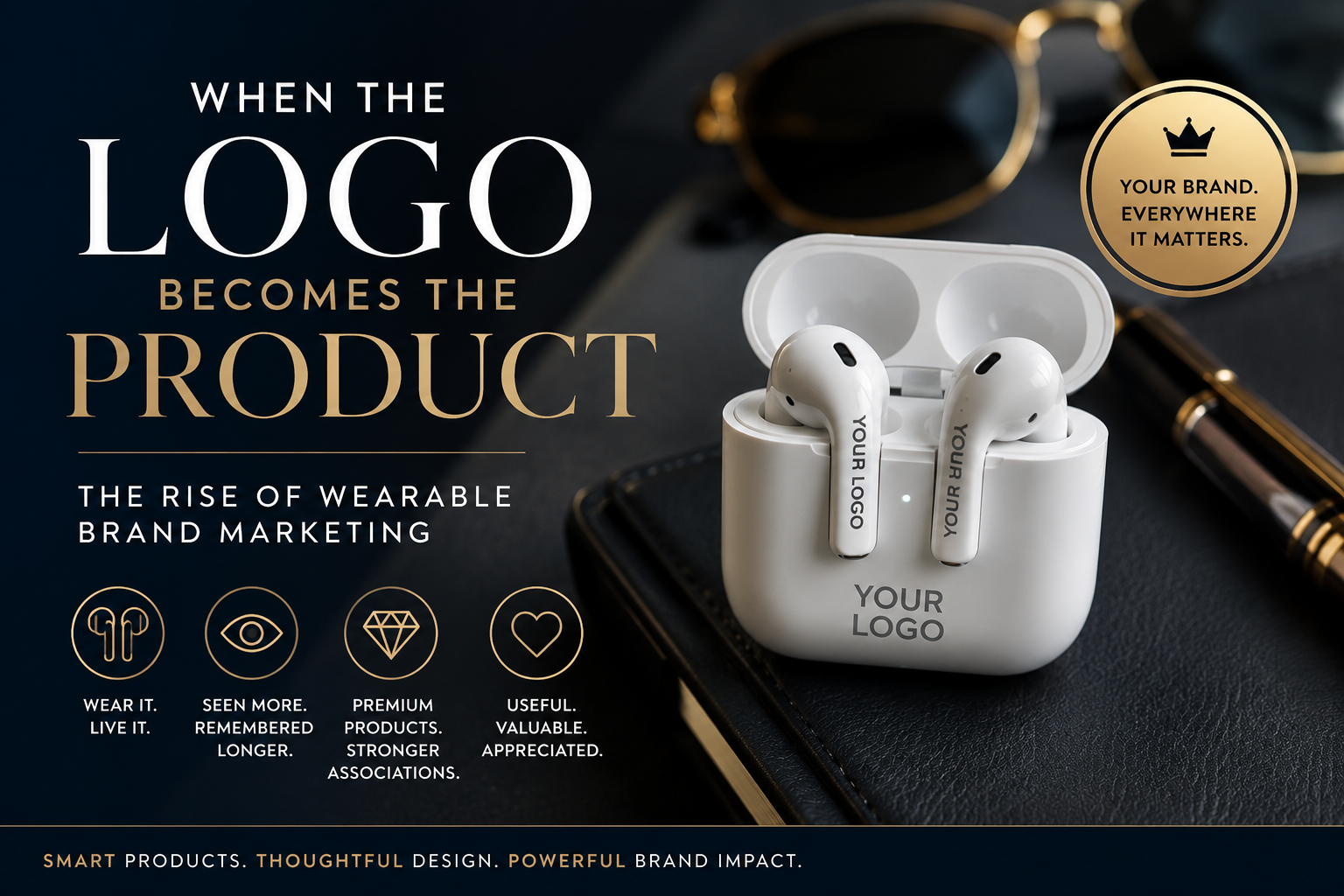
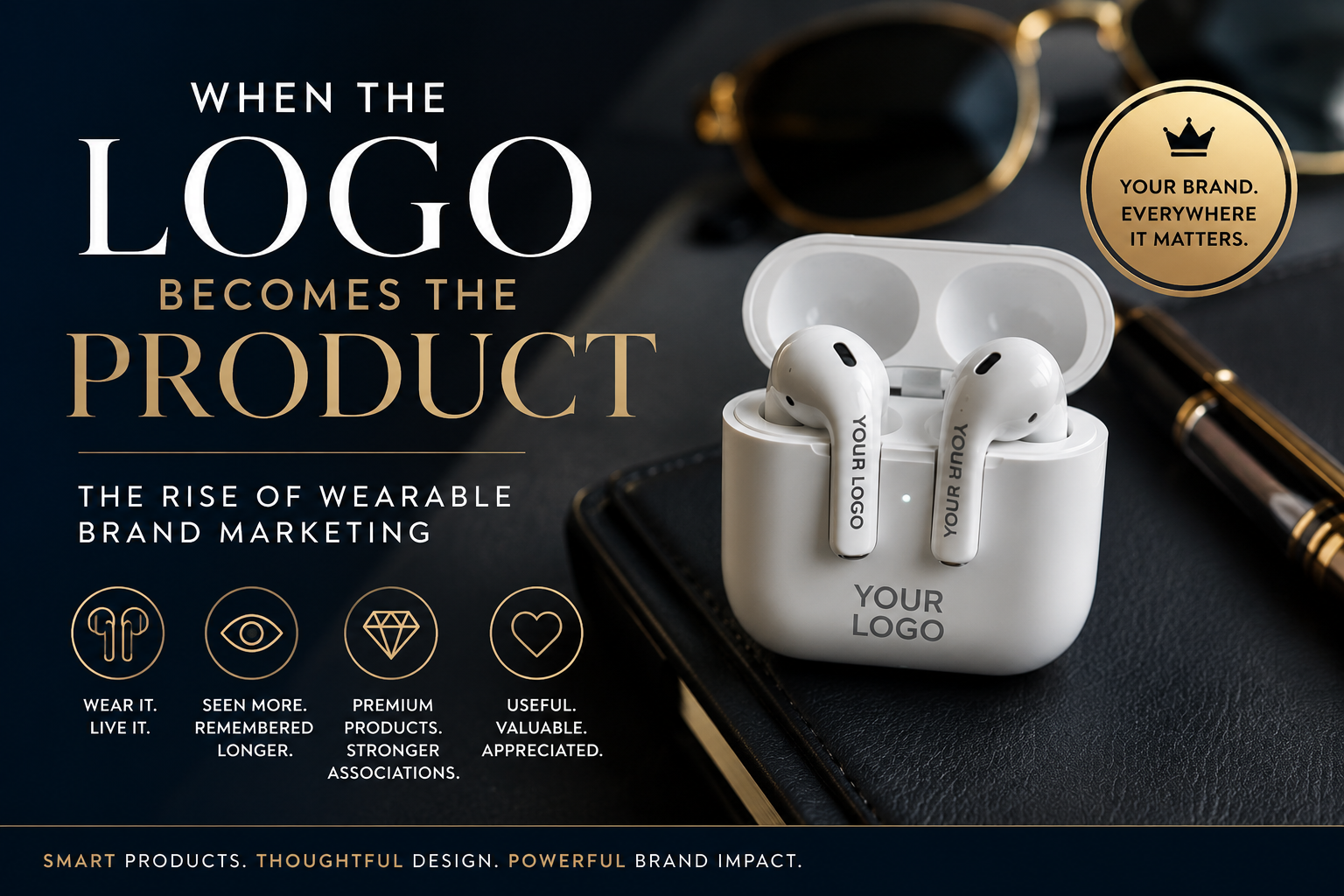
Consider a pair of wireless earbuds.
A logo printed on the charging case may be visible when the case is sitting on a desk or when someone opens it. But branding incorporated directly into the earbuds themselves creates an entirely different relationship between the product and the brand.
The product is no longer simply carrying the logo.
The product is wearing the logo.
That distinction may seem subtle, but it represents a larger evolution in promotional marketing: brands are beginning to think about customization as part of product design rather than an afterthought.
When Branding Becomes Part of Personal Style
Technology has become surprisingly personal.
People choose headphones based on sound, comfort, design, color, and how they fit into their lifestyle. They take them to airports, coffee shops, offices, campuses, gyms, and sporting events.
That makes wearable technology particularly interesting for marketers.
A branded pair of earbuds can become part of someone's morning commute. Headphones can become part of an employee's workday. A premium audio product can accompany a client on a business trip.
The brand travels with the recipient.
This is fundamentally different from a promotional product that remains in a desk drawer.
The recipient isn't simply seeing the brand once. They may encounter it repeatedly through everyday use—and people around them may see it as well.
The promotional product becomes a moving brand impression.
Why Useful Products Have Greater Staying Power
There is a practical reason this matters.
People keep things they find useful.
The Advertising Specialty Institute's 2026 Ad Impressions Study found that 78% of U.S. consumers would keep a promotional product because it is useful. The study also found that 79% of consumers reported a more favorable impression of an advertiser after receiving promotional merchandise.
That reinforces an important principle of promotional marketing: the value of the product influences the value of the marketing.
If the recipient needs the product, likes the product, and uses the product, the brand benefits from that relationship over time.
A power bank solves a universal problem. A pair of headphones supports work and entertainment. A wireless charger becomes part of a workspace.
These aren't products people necessarily need to be convinced to use.
They're already part of modern life.
Premium Products Change the Conversation
There is another factor marketers should consider: perceived value.
The product selected for a campaign communicates something about the organization giving it.
A premium technology product can make an employee feel appreciated. It can elevate a client gift. It can make an event giveaway feel more substantial.
And when the underlying product carries a recognized retail name, the perceived value can become even stronger.
Brands such as Apple, Bose, JBL, Beats, and Amazon already have significant recognition with consumers. Combining that recognition with thoughtful promotional customization creates a powerful marketing equation:
Recognized product + meaningful utility + distinctive branding = a stronger brand experience.
This is especially relevant for companies competing for attention in crowded markets.
Customization Is Becoming More Sophisticated
Today's promotional technology doesn't have to look like a generic product with a logo placed on the most convenient surface.
Brands can increasingly think about the entire presentation.
Color can become part of the campaign. Packaging can become part of the experience. Accessories can be customized. Graphics can be designed specifically for the campaign.
And even the placement of the logo can become strategic.
For a premium campaign, the goal isn't necessarily to make the branding as large as possible.
The goal is to make it feel intentional.
A sophisticated logo treatment can make a promotional product feel more like a limited-edition brand collaboration than traditional merchandise.
From Giveaway to Brand Experience
This is perhaps the biggest change taking place in promotional marketing.
The objective is no longer simply to give someone something with your logo on it.
The objective is to create an experience that reinforces how you want people to perceive your company.
An executive receiving premium headphones should feel that the gift reflects the value of the relationship.
An employee receiving customized earbuds should feel recognized.
A customer receiving a thoughtfully branded technology product should feel that the company made a deliberate choice rather than simply ordering something in bulk.
That emotional response is part of the marketing.
Ask a Different Question
When planning a promotional campaign, it is easy to begin with the logo.
Where will it go?
How large will it be?
How many colors?
But a stronger strategy begins somewhere else.
What do we want people to experience when they receive our brand?
From there, the product selection becomes more intentional.
Will they use it?
Will they keep it?
Does it fit their lifestyle?
Does the design feel worthy of our brand?
Will the product still be relevant six months from now?
These questions lead marketers away from merchandise and toward brand experiences.
The Future of Promotional Marketing Is More Personal
The promotional industry is evolving alongside consumer behavior.
People have more products, more advertising, and more choices competing for their attention than ever before. The brands that stand out won't necessarily be the ones with the biggest logos.
They will be the ones that create something people genuinely want to keep.
Something useful.
Something desirable.
Something that fits naturally into everyday life.
And increasingly, something that people are proud to carry or wear.
That is why technology has become such a compelling category for promotional marketing.
A pair of earbuds can become part of someone's personal style. A power bank can become a daily essential. A premium speaker can become part of someone's home. A wireless charger can become part of someone's workspace.
The brand becomes associated with those experiences.
That's when promotional marketing becomes more than putting a logo on a product.
The product becomes a reflection of the brand itself.
And sometimes, the most powerful place for a logo isn't on the box.
It's on something people actually want to wear.